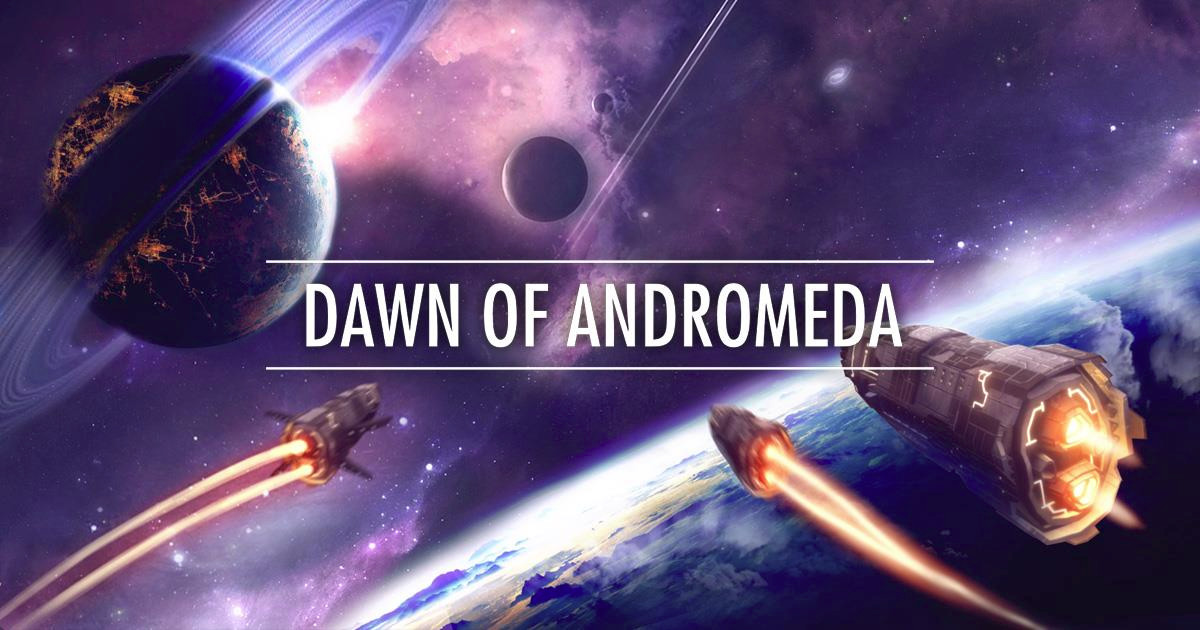
Dawn of Andromeda is a pausable, real-time space 4X game focused on providing a fun, immersive and accessible experience that allows you to truly play as an emperor. Build your empire, colonize new planets, interact with other factions and characters, research new technologies and build fleets so powerful your enemies will tremble.
IntroductionIt’s been a while since I played a 4X/RTS hybrid. Despite leaving its Early Access stage yesterday, Dawn of Andromeda proves that a video game which shows great promise, can also keep its word in terms of promises made to its players and early buyers/supporters. Nonetheless, it is the Steam debut of its developer, Grey Wolf Entertainment.StoryI was play testing extensively the Early Access when out of the blue, that stage was over and I could finally sink my teeth into the proper Dawn of Andromeda storyline. The highly anticipated (by me) Eras. Gas guzzlers extreme trainer.
You may consider them scenarios focusing on very specific objectives and struggles between two or more factions. Before the campaign was launched, I had to contend with a sandbox mode of sorts, titled “Custom Game”. It was more than fine yet it could hardly fill the void for a proper story.
Along came the Eras and while I shall not spoil anything to you, know that its main plot line focuses on the causes and effects of a cataclysmic event, triggered by mindless warfare and religious zealotry. Why does it sound so familiar to me?GraphicsIt’s still debatable if Dawn of Andromeda’s graphics engine is running Unity 5 assets, but as far as players are concerned, the game looks gorgeous. In the several hours I spent building up my galactic empires, I haven’t met a single bug, glitch or crash to desktop.
The frame rate was constantly pushing 60 FPS while rendering at 4K resolution. An Early Access that features absolutely no technical issues isn’t something you take for granted. I have obviously met none, even after two days since the game’s full release. Textures were featuring the right amount of detail and variety, but I’d still like to see more ship design features, other than a few templates that only have modifiable loadouts and no aesthetic options as well. At least the chance to alter the faction and unit color schemes would be welcome.AudioThe sounds are not quite on par with the eye candy in Dawn of Andromeda. Sure, the soundtrack is a soothing and genre specific, yet the sound effects are lacking in diversity and there is absolutely no voice acting. Not for the intro cinematics or for the various task and interface screens between major or minor species.
I probably got too used to the diplomatic screen from the more recent Civilization titles, but I’d like at least a few lines of spoken dialogue when interacting with the AI allies or foes. We’re negotiating intergalactic peace over here, so they should spare the time to properly thank me for that.GameplayI mentioned in the Introduction section two acronyms. Perhaps some of you are more familiar to RTS (real time strategy) than 4X (“eXplore, eXpand, eXploit, and eXterminate”), yet they both represent old school staples of the strategic gaming genre. Recent years may have been less kind to 4X since this subgenre has always been harder to implement or improve over the existing formula (micromanagement can rarely get streamlined), but I still like to think that it’s more than just a niche demand for strategy games that incorporate in-depth elements of politics and diplomacy, because 4X is as much about waging total war as it is about brokering a lasting peace. Ensuring technological advancement, without neglecting society’s constant need for changes in its structure.
Politics may be a dreary subject to some players, yet such video games may present a more “digestible” version to the real life negotiations which are never as smooth or straightforward as the mass media portrays them.The Artificial Intelligence in 4X games needs to be sharper than in many other strategic subgenres, since the gameplay is more static. Even in Dawn of Andromeda’s case, where you experience all the drama and joys of empire building in real time, you will pause the game often enough or at least play at half the “normal” speed. Many decisions to consider, orders to issue and planning your next move should never be rushed, unless you wish to gamble away your units or survival odds. In the Eras campaigns, the AI cannot be fiddled with, but I found its tweaking options in the sandbox mode to be quite efficient. Playing in an custom galaxy and with the specific factions you desire as your competitors, you can set their behavior to either Expansionist, Survivalist or Diplomatic. It goes without saying that if you wish to play the game at a considerably slower pace, you must set your future AI rivals to a more Diplomatic conduct and you can then research the entire tech tree in Dawn of Andromeda before they’d dare to lift a finger against you, no matter how close you get to their homeland.Speaking of acquiring new territories, colonial expansion is the bread and butter in Dawn of Andromeda. Your fleets of space ships can be assigned certain roles, such as mining resource-rich asteroids, surveying anomalies or colonizing other planets.
Right from the start, you won’t be able to expand on every single world you set your eyes upon, but with proper research in a few unlockable projects, you may inhabit even the most inhospitable environment if you’re interested in the resources hosted by the planet in question. Trading with the other species you encounter, will be your second most important source of income, after taxation itself. You will need all the credits you can squeeze from your citizens, in order to assemble and maintain an efficient defensive fleet.I hope the dev team shall add the option of retrofitting the ships with newly researched tech advancements, instead of forcing me to disband units and commission new vessels in their place. Never mind the cost, it’s a time consuming process which could spell disaster during an ongoing conflict. You have full control over all crucial aspects of you space empire.
You influence the finances, industry, agriculture, diplomacy, internal policies, military and research efforts. If that doesn’t sound like an easy job, it probably ain’t. But this is a video game and unlike real life, you can always load a previous save file, if you think you screwed up things beyond repair. Ideology also plays an important role and your Council of ministers/governors needs to be reconciled, lest you invite rebellion or civil war upon your doorstep.
You will understand soon enough that democracy is just the compromise you accept out of fear for its alternatives.VerdictDawn of Andromeda is a real-time 4X strategy title done right. It doesn’t sacrifice well established gameplay mechanics for the sake of “modernity”. It’s streamlined enough to appease new players but at the same time, it doesn’t antagonize the subgenre veterans. If you consider it overpriced, just wait for a bundled offer or better yet, a Steam Sale which is more predictable. In case you’re wondering why even old 4X games are seemingly overpriced, you need to understand that the AI, interface complexity and potential for hundreds of gameplay hours, cannot be offered at the price tag of more simple and repetitive genres. Don’t compare apples to oranges. They are priced accordingly.
Moto x mayhem free. Even if you’re not a die-hard fan of strategy, Dawn of Andromeda’s tutorial screens will guide you towards the galactic conquest you’ve always dreamed of!All the screenshots you see above, have been taken by me in-game through the Steam Overlay.
What is it about?showcases a series of missions called “Eras” that portray an intergalactic fight among space-faring nations with each Era having its own context and pre-defined objectives. Dawn of Andromeda uses these missions as a storyline for players, featuring the ascension of humanity into a galactic empire and conflicts fought against other sentient species. Each Era objective is self-contained, where player actions and changes to the environment do not carry over to the next one. During the first Era (minor spoiler) humanity is greeted by friendly Sythons with words of friendship and promises of co-existence which are later betrayed, forcing on players the troublesome task of surviving for two years.While humanity may have had a troublesome first encounter with the Sython, a common foe twists the plot and forces them into a last stand alliance to defend their homeland and the very survival of their species. Dawn of Andromeda gives up the free play “build your own adventure”-ish mechanics other games have for these pre-defined Eras missions, focusing mostly on the story. Whether this was a good idea or not depends on one’s expectations.Dawn of Andromeda on May 4th after “several months successfully in Early Access”.
Thankfully the game is singleplayer only, otherwise, a number of players would make for a very boring experience. According to, the average number of players in the Last 30 Days were 4.6 players, a very low amount for such a nice-looking game that definitely took some effort. Of course, during its Early Access period, it did not do well either with player counts, with previous months having even fewer players on average, hitting the lowest in March, with 2.9 average players. One may argue that the game is dead, but it was never alive.
Not that this is a problem for a singleplayer experience as the player base won’t harm gameplay, but it is an indicator of the people enjoying the game and that further development of content is unlikely.Nevertheless, Dawn of Andromeda is different from other offerings in the market with simple gameplay focused on storytelling rather than 4X strategy. Dawn of Andromeda did manage to handle the storytelling nicely, with those pre-defined missions helping shape the narrative course. However, do its mechanics manage to keep the experience fun for 4X fans? After all, it targets a 4X market and instead offers storytelling. How well will it please 4X fans? GameplayWhen comparing Dawn of Andromeda to other 4X space games, such as the hit Stellaris, it is clear that Dawn of Andromeda uses much simpler mechanics than the latter, with one good example being planetary invasions.
When playing Stellaris and starting a planetary invasion, ground troops will be needed to further secure the planet after orbital bombardment has gone its course (what takes time). On the other hand, Dawn of Andromeda only uses a quick orbital bombardment to take control of a planet without the need for a ground invasion or anything of the like, making the simplistic mechanics obvious to any 4X player.Instead of featuring multiple different resources for building fleets, all it uses is in-game currency, called Credits. While playing Stellaris and other similar games one may need resources such as “ore”, “energy” or something similar. In Dawn of Andromeda, all it takes are Credits that take ages to collect and do not have a clear indicator of where they are coming from.
Surely, the planet may be taxed, but what commerce or buildings are being taxed?Dawn of Andromeda does not feature direct building for planetary structures, but rather ‘investment points’ which can be focused on five trees, giving production buffers to the planet. This way, instead of building, say, 10x “Housing Block I”, players allocate investment points according to need. Not only is this unclear and not immersive, it makes the game even more simple in comparison to other 4X games, keeping away 4X fans looking for a more complex experience. Another problem regarding investment points is that they cost in-game currency, which is hard to get and used for pretty much anything due to a lack of other resources. Instead of having “ores” that may be allocated to construction, credits are used.
The very same credits that are used to keep fleets working and at top efficiency.Fleets are an overstatement, as what one may actually manage to gather are a dozen ships at best due to their high costs and they do not work as groups. They have to be either selected individually one by one or taken by dragging the mouse and selecting them all at once.
Of course, this is nothing like other major names of the 4X genre, such as Endless Space. In Endless Space, there are cohesive fleets that work as squads with actual admirals assigned to them, giving them a boost that significantly helps to combat against A.I or whatever is being faced. Dawn of Andromeda has another simplistic point in fleet mechanics and combat, with combat being very dull as both “”fleets”” stand at each side firing at each other until the side with most ships wins. There is no actual regard to countering armor or the like as is done in Endless Space and Stellaris. Even though Dawn of Andromeda does feature a ship designer, it’s usefulness is limited as pre-defined missions do not require going such lengths and it’s pretty much a redundant feature.
In the ship designer, it is possible to modify designs or create new ones using researched technology, needing to respect the ship’s “maximum tonnage”, similar to Endless Space. Stellaris also has a modification limit but uses Energy and reactors for balance.While Dawn of Andromeda does have multiple factors that hinder its ability to be attractive to 4X fans (seriously, Endless Space Collection is way cheaper and way more complex!), not all its mechanics are bad. If there is something the game completely nailed in a good sense, it is diplomacy. Dawn of Andromeda‘s diplomacy has important advantages in relation to Stellaris. For example, in Stellaris diplomacy is really dull and simplistic, with useless federations. In Dawn of Andromeda, players can pay small faring states in order to wage war against another, or pressure them into waging a proxy war using an “Ultimatum”. In an “Ultimatum”, a nation can use its own resources in order to pressure another nation into accepting its terms under threats of doing something, so the extortion of weaker nations is possible without a need for war.
In this regard, Dawn of Andromeda does not lack. This is specifically useful during Eras where Sython and Terrans are at a stalemate and having smaller nations fight proxy wars does help turn the tide.A negative point to keep in mind, though, is how colonizing is uncertain. There is no clear indicator of whether or not it’s going to succeed. Indeed, while the game’s interface may claim the planet is colonizable, once the colonists land they may suddenly die for a vast number of reasons. Of course, this is a realistic mechanic but due to no clear indicator of the probability of such catastrophe, it turns into something negative and does not help make the game more fun.Last, and not least, is Science. Science has to be the most simplistic aspect of Dawn of Andromeda, with one “Science” resource responsible for tech research, unlike Stellaris and Endless Space where multiple “Science” resources are used for different research trees.
For example, Stellaris has Society, Physics, and Engineering and Endless Space has Science, Industry and Food (FIDS). Each one of those resources is responsible for researching a certain tech with a distinctive aspect. In Stellaris for example, can be used to research society. Food, in Endless Space, for Dust, the in-game currency similar to Dawn of Andromeda‘s Credits. Meanwhile, Dawn of Andromeda only has one scientific resource, a generic “Science”.While Dawn of Andromeda may have its share of negative and positive points, it makes up for that with content. Whether or not the content will please depends on how well the simplicity of the game is accepted, with a chance of the storytelling to fall into a repetitive loop. ContentThe game features 8 Eras, with an increasingly difficult objective.
Players looking to enjoy the story and ignore the sheer simplicity of the mechanics will notice that most people have not gone past the first Era. If the global achievements are to be taken into account,. Likely because of the difficulty. The game does not have configurable difficulty settings and players will often have to replay an Era as it is not forgiving. The average time to beat, according to my own assumptions, would be 1 hour per Era, with the eventual replay.
A good guess is the game would last about 10 hours. Final ThoughtsDawn of Andromeda is relatively fun but does not manage to break any new ground and will likely not please 4X fans due to its simplicity and may not please those who simply listen to story telling due to it’s rather unforgiving AI. The lack of content and mechanics is not justifiable, with significantly better games such as Endless Space 1 for the same price. While not inherently bad, Dawn of Andromeda cannot be rated anything more than a Pause as there are good bits that were overseen by bigger games (such as its diplomacy gameplay), but the major lack of mechanics makes it a bit boring.
Buy this game on sale and do not jump in with high expectations.
Top Posts
- Warborn Clan Symbols
- Case Clicker Codes
- Escape The Pacific 1943
- Hexagonal Minesweeper Download
- Animal Jam Game
- Tomba La Bomba
- Bravelands Wiki
- Nihilumbra Free Download
- Nancy Drew Alibi In Ashes Amazon
- Kill Shot King Photos
- Trenches Instrumental
- Stephens Sausage Roll Story
- Castle Of Illusion Starring Mickey Mouse No Damage
- Pixeljunk Shooter Ultimate Download