Dish Soap Dispenser: Add a pour-top to an old wine bottle to make a dish soap dispenser or to store any other liquid ingredients. Will you try to make these wine bottle tiki torches? How do you reuse old bottles? (And please let me know if you have other ideas for date nights in!).
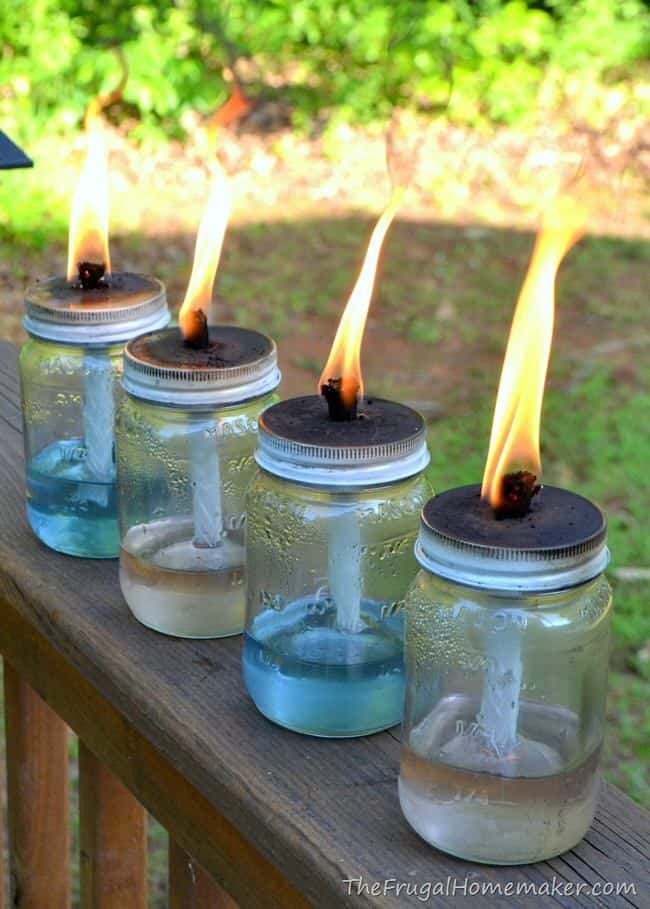
The tiki torch is a popular outdoor party decoration. Commonly used for backyard luaus, the torches are both practical and festive. Tiki torches can be purchased ready made, or can be created at home by handy individuals who are looking to save a few bucks. If you’re making your own tiki torches, one of the key elements is the wick. By following the instructions here, you will be able to create your own cotton wick, which will draw the oil up into the flame to be burned.
Depending on what combination of salt and water you soak your wicking material in, you can create a flame that will burn any color from standard bright orange to green or blue or purple. Remove the strings and use the clothespins to hang them to dry. Allow the strings to dry for at least 5 days.Braid the strings together when they are completely dry to form a simple wick. You can store unused wicks by rolling them in old newspaper and placing them in a cool, dry area.Take the wire and wrap it around a small twig or a nail to form a coil. Make the last loop of the wire wider than the rest so the coil will stand on its own. Insert the braided wick into the coil so that it extends about ¼ inch above the wick holder.

A torch is a stick with combustible material at one end, which is ignited and used as a light source.[1] Torches have been used throughout history, and are still used in processions, symbolic and religious events, and in juggling entertainment. In some countries 'torch' in modern usage is the term for a battery-operated portable light.
Etymology[edit]
From the Old French 'torche' meaning 'twisted thing', hence 'torch formed of twisted tow dipped in wax', probably from Vulgar Latin *torca, alteration of Late Latin torqua, variant of classical Latin torques 'collar of twisted metal', from torquere 'to twist'.[2]
Torch construction[edit]
Torch construction has varied through history depending on the torch's purpose. Torches were usually constructed of a wooden stave with one end wrapped in a material which was soaked in a flammable substance. In ancient Rome some torches were made of sulfur mixed with lime. This meant that the fire would not diminish after being plunged into water. Modern procession torches are made from coarse hessian rolled into a tube and soaked in wax. A wooden handle is usually used, and a cardboard collar is attached to deflect any wax droplets. They are an easy, safe and relatively cheap way to hold a flame aloft in a parade or to provide illumination in any after-dark celebration.
Battle path 3d cheats. Modern torches suitable for juggling are made of a wooden-and-metal or metal-only stave with one end wrapped in a Kevlar wick. This wick is soaked in a flammable liquid, usually paraffin (kerosene).
Symbolism[edit]
The torch is a common emblem of both enlightenment and hope.[3] Thus the Statue of Liberty, actually 'Liberty Enlightening the World', lifts her torch. Crossed reversed torches were signs of mourning that appear on Greek and Roman funerary monuments—a torch pointed downwards symbolizes death, while a torch held up symbolizes life, truth and the regenerative power of flame. The torch is also a symbol used by political parties, for instance by both Labour (from 1918 to 1980) and the Conservatives (from 1983 to 2006) in the UK, and the Malta Labour Party. In the seals of schools in the Philippines, the torch symbolizes the vision of education to provide enlightenment to all the students.
Uses[edit]
Olympics[edit]
A torch carried in relay by runners is used to light the Olympic flame which burns without interruption until the end of the Games. These torches and the relay tradition were introduced in the 1936 Summer Olympics by Carl Diem, the chairman of the event because during the duration of the Ancient Olympic Games in Olympia, a sacred flame burnt inside of the temple of Hera, kept in custody by her priestess.
Juggling[edit]
Juggling torches are often used as a prop in toss juggling: they can be flipped into the air in an end-over-end motion while being juggled, in the same manner as juggling clubs or juggling knives, but because of their sound and 'trail of flame', they can appear much more impressive to audiences. To a skilled juggler, there is only a slight chance of being burned, but they are still dangerous.
In Roman Catholic liturgy[edit]
In former times, liturgical torches were carried in Eucharistic processions simply to give light. The Church eventually adopted their use for Solemn High Masses.
According to Adrian Fortescue,[4] the more correct form of liturgical torches are non-freestanding (i.e. cannot stand up on their own). However, today, even in the Vatican, freestanding, tall candles in ornate candle-stick holders have replaced the former type. The torches are carried by torchbearers, who enter at the Sanctus and leave after Communion.
Anglicans of the High Church and some Lutherans use torches in some of their liturgical celebrations as well.
Torchlight march[edit]
Torchlight march is a type of illuminated procession which is held after dark so that torches carried by the participants form a spectacle (other types of an illuminated procession involve candles, lanterns etc).[5]
Associations[edit]
Love[edit]
The association of a torch with love may date to the Greek and Roman tradition of a wedding torch,[6]lit in the bride's hearth on her wedding night, then used to light the hearth in her new home. Such a torch is associated with the Greek god of marriage Hymen.
The idiom to carry a torch (for someone) means to love or to be romanticallyinfatuated with someone, especially when such feelings are not reciprocated. It is often used to characterize a situation in which a romantic relationship has ended, but where one partner still loves the other. It is considered by some to be dated,[7] but still in wide usage. A torch song is typically a sentimental love song in which a singer laments an unrequited love.
Gallery[edit]
A tiki torch
Torch seller, tacuinum sanitatis casanatensis (14th century)
18 November Torchlight procession 2013 in Riga, Latvia
Bonfire Night celebrations in Lewes, Sussex on 5 November
A torch on the Flag of Zaire, 1971-1997
See also[edit]
References[edit]
- ^merriam-webster.com
- ^'Torch'. Etymology. Retrieved 27 February 2018.
- ^Lindberg-Wada, Gunilla (1 January 2006). Studying Transcultural Literary History. Walter de Gruyter. ISBN9783110920550.
- ^'The Mass: A Study of the Roman Liturgy [1912]'
- ^Beverly N. White. 'Torch Light'. Retrieved 7 June 2013.
- ^Re: To 'hold a candle' for someone – The Phrase Finder
- ^WordReference Forums – carry a torch for someone
External links[edit]
| Look up carry a torch for in Wiktionary, the free dictionary. |
| Look up torch in Wiktionary, the free dictionary. |
| Wikimedia Commons has media related to Torch. |
- Picture of non-freestanding torches Antique Liturgical Torches in Procession
- Picture of non-freestanding torches Antique Liturgical Torches in Procession